
Vegan iPad sleeve: two materials you would not expect inside
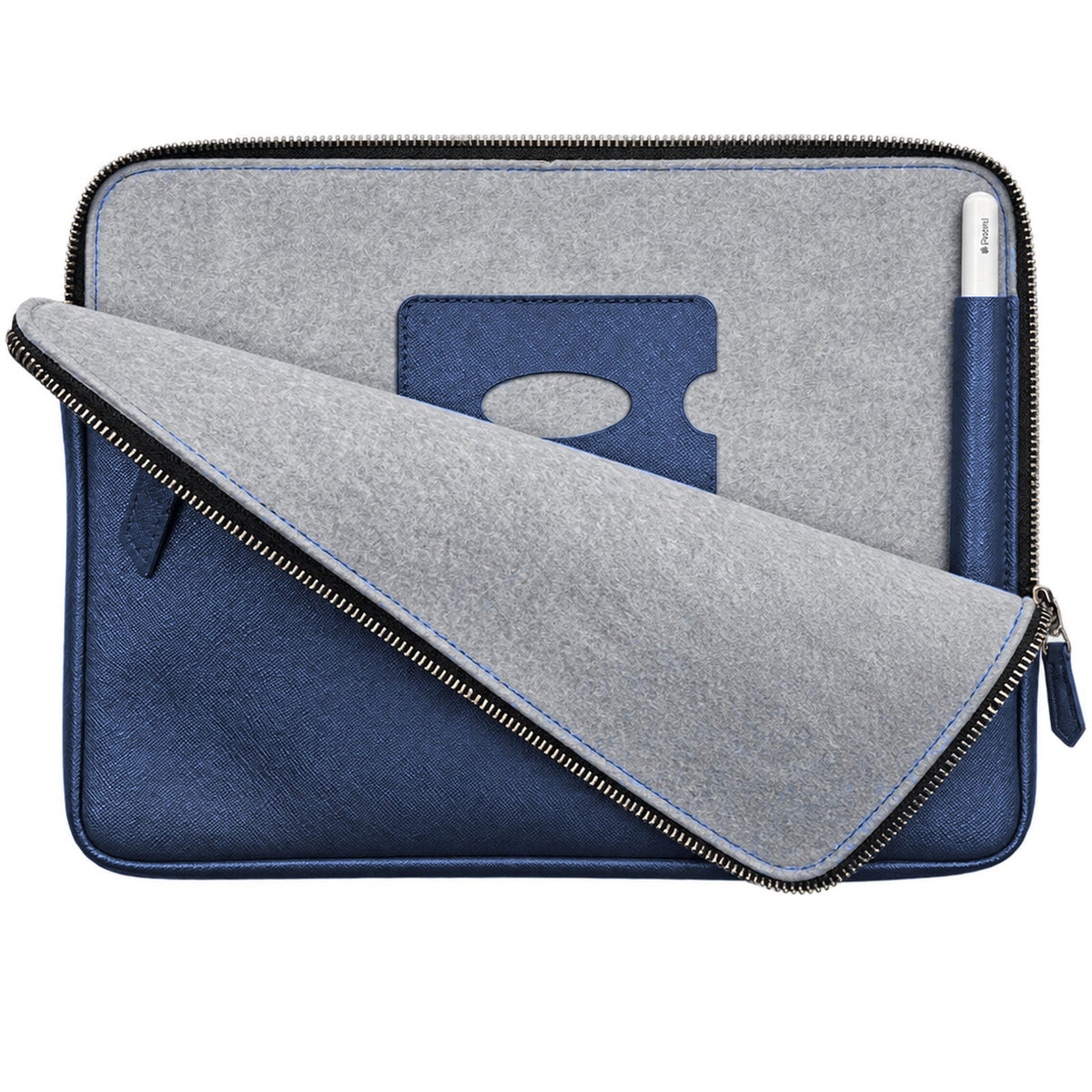
One comes from an oil mill in southern Europe. The other starts as sugar that bacteria ferment – the same process that turns milk into yoghurt. Two materials you would not expect inside an iPad sleeve.
How they are made, why the surface looks the way it does, and what the felt inside actually does: a materials guide from our workshop in Hamburg.


Where animal materials hide in bags and sleeves
A sleeve is not made of one material but of half a dozen: outer layer, lining, thread, zip tape, adhesive, sometimes an insert. The obvious one is the outer layer. Leather is leather, everybody knows that. The other places are less known:
- The lining. Wool felt is a natural material from sheep. An excellent one – but animal.
- The adhesive. Classic glues in leather work were bone or hide glues for decades. Most are synthetic today, but „most" is not an assurance.
- The thread. Sewing thread is almost always polyester now. On high-end leather goods you also find waxed linen thread – and that wax can be beeswax.
- The finish. Some textiles are treated with agents that contain animal fats. That is declared nowhere.
So building a sleeve without animal materials does not mean replacing one material. It means checking a whole chain. That was the laborious part: not deciding on a material, but clearing up every single position.
Saffiano: the grain that breaks the light
The surface of our vegan sleeve carries a saffiano grain. The name is everywhere these days, but few people know where it comes from.
Saffiano is not a type of leather, it is an embossing pattern: fine crossing diagonal lines pressed into the surface under heat and pressure. The technique comes from Italian leather work and is more than a hundred years old. Its purpose was never decoration – the cross grain makes a surface more resistant to scratches and abrasion, because small marks disappear into the pattern instead of standing out.
There is a second effect, and it is optical. A smooth surface reflects light as a bright patch. A cross grain breaks it in many directions. That is why saffiano surfaces look calm, even in direct light.
Olive pomace: Europe's most underrated residue
To see why Oleatex is possible at all, one figure from olive oil production helps: 100 kilograms of olives yield roughly 20 kilograms of oil, depending on variety and process. The rest is pomace – skins, pulp, pieces of stone, mixed with residual water.
This pomace is not waste in the strict sense, but a raw material that had few takers for a long time. It is damp, it spoils quickly, and in the Mediterranean countries it comes in enormous seasonal quantities, all at the same time.
That a flat, sewable material can be made from it is comparatively new. The pomace is dried, ground and processed into a mass that is applied to a carrier fabric and then embossed.
To be straight about it: Oleatex is a composite material. Olive pomace is the starting material, not the only component. That is why we do not call it „vegan leather" – the term suggests it is leather, only without the animal. It is not. It is a material of its own, with its own look and its own properties.
Polylactide: a plastic that starts as sugar
The first fibre in our lining is called polylactide, PLA for short. The name sounds like a chemistry lab; the route to it is surprisingly tangible.
It begins with plant sugar. Bacteria ferment it – the same process that turns milk into yoghurt and dough into sourdough. What forms is lactic acid. Let many lactic acid molecules link up and you get a chain: a polymer. From that polymer a thread can be drawn, spun and woven like any other textile fibre.
PLA is not a niche material. It is in compostable coffee capsules, in tea bags, in 3D printer filament and in resorbable surgical suture – thread that dissolves in the body by itself. That felt can be made from it too is a comparatively recent application.
Lyocell: the second fibre
The second fibre comes from cellulose, the substance plant cell walls are made of. In the trade you usually meet it under brand names.
What is special about the lyocell process is the solvent: the cellulose is dissolved in a loop that is very largely recovered and reused. It was not always so – older processes for making cellulose fibres worked with considerably more problematic chemicals.
Lyocell brings properties PLA does not have: it takes up moisture and releases it again, and it is softer to the touch. Blending the two gives a felt that keeps its shape and still feels pleasant.

The two materials side by side
| Oleatex · outside | Violan · inside | |
|---|---|---|
| Starting material | Olive pomace from the mill | Plant sugar and cellulose |
| Made by | Drying, grinding, applying, embossing | Fermenting to lactic acid, spinning, felting |
| Surface | Saffiano cross grain, tactile | Random-fibre web, matt and soft |
| Job | Shape and protection outside | Cushioning, separation from the zip |
| Thickness | thin, on a carrier fabric | 3 mm |
| Care | wipe with a damp cloth, no grease | brush out |
What both have in common: their starting material is a residue that had no use before – one from the oil mill, one from plant and wood residues.
Why felt at all?
A lining in a device sleeve has two jobs, and both are unspectacular: it should cushion, and it should keep the device from touching the zip.
Felt does both particularly well because it is a random-fibre web – the fibres do not run in parallel as in a woven fabric but in every direction. It therefore cushions evenly in all directions and does not fray at cut edges. That is why felt needs no folded seam, which in turn saves height.
What becomes of it in Hamburg
Both materials end up in the same workshop we have worked in since 2011. The shape already existed: the ANGUS has been in the range for years, until now in leather with wool felt.
That is why the vegan version is not an experiment. The patterns are there, the steps are practised, the fit has been corrected over years. The two materials are the only new part.
It is stitched with recycled thread. The zip comes from YKK.

Care: what this material needs and what it does not
The biggest practical difference to leather shows in the care, and it is a welcome one: there is almost none.
Leather lives on being fed, because the fats outgas over the years and the fibres would otherwise turn brittle. Oleatex has no such mechanism. It needs no grease, no polish, no impregnating spray.
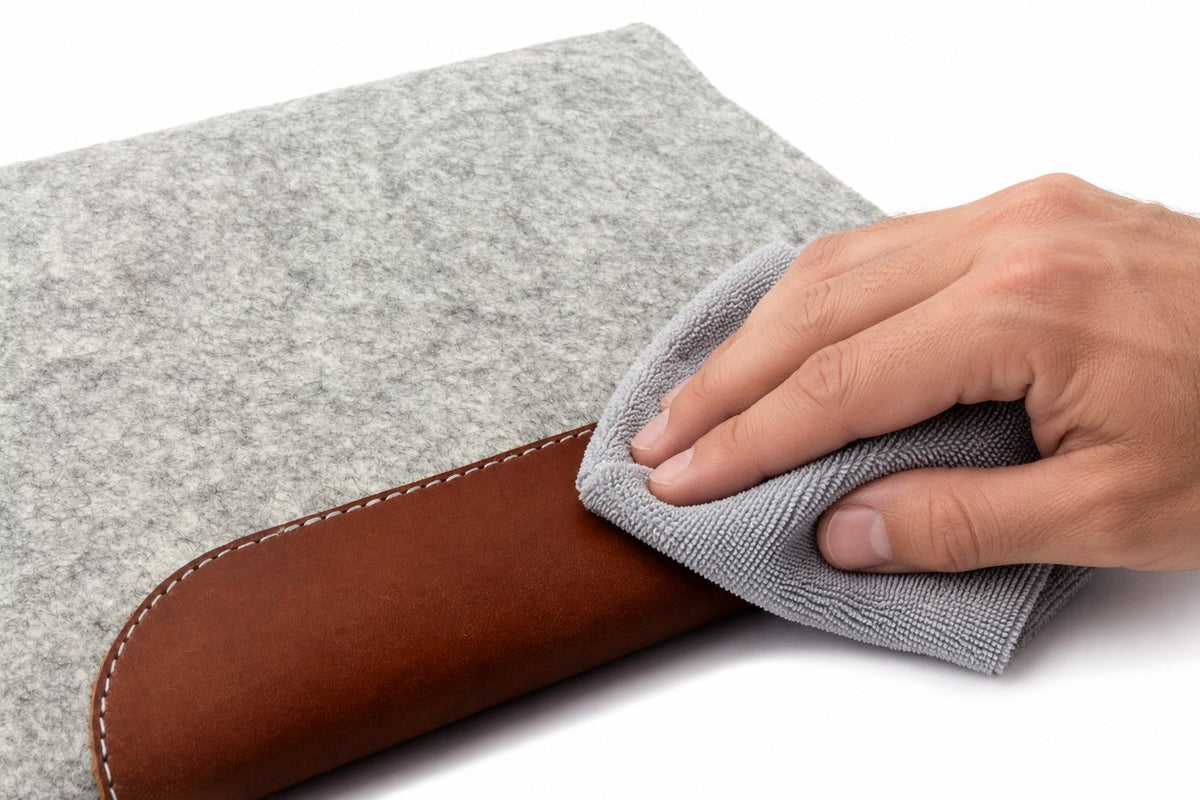
What helps: take dust and handling marks off with a slightly damp cloth, then wipe dry. No solvents, no alcohol, no abrasives – those attack the grain.
The felt inside comes clean with a soft brush. Crumbs, sand and dust collect mainly in the corners; turning it over and shaking it out usually does the job.
What the material does not like: standing wet and strong heat. A sleeve that spends a summer day in a car in the sun is not a warranty case – but no material enjoys it.
Common questions
Is polylactide a plastic?
Yes. It is a polymer, so chemically speaking a plastic – only one whose starting material does not come from crude oil but from fermented plant sugar. „Bio-based" says something about origin, not automatically about breaking down in nature.
Is the sleeve compostable?
No. Individual fibres would be degradable under industrial conditions; the finished product is not – it is stitched, bonded and fitted with metal. A sleeve that lasts a long time is the more sensible calculation anyway.
Does Oleatex smell of olives?
No. Nothing of the starting material remains in the finished material in terms of smell.
Does the material rub off?
No. Unlike vegetable-tanned leather, which can transfer colour when wet in the first weeks, the surface is colour-stable.
Is there an ANGUS in leather as well?
Yes, the leather ANGUS is built the same way, with vegetable-tanned cowhide and merino wool felt.
In closing
What is in the ANGUS Vegan can be said in one sentence: two materials obtained from plant residues, made up in Hamburg, with nothing of animal origin – not in the outer material, not in the lining, not in the thread.
Everything else – measurements, sizes, what fits inside – is on the product page.