





Genuine materials. Genuine handcraft. For Apple, from the early days to today.
About Pack & Smooch

In our Hamburg workshop, we design and craft products that last. Made from Merino felt and vegetable-tanned leather, hand-finished in small batches. Every piece is created with calm precision and honest intent—timeless in design, durable in everyday use.
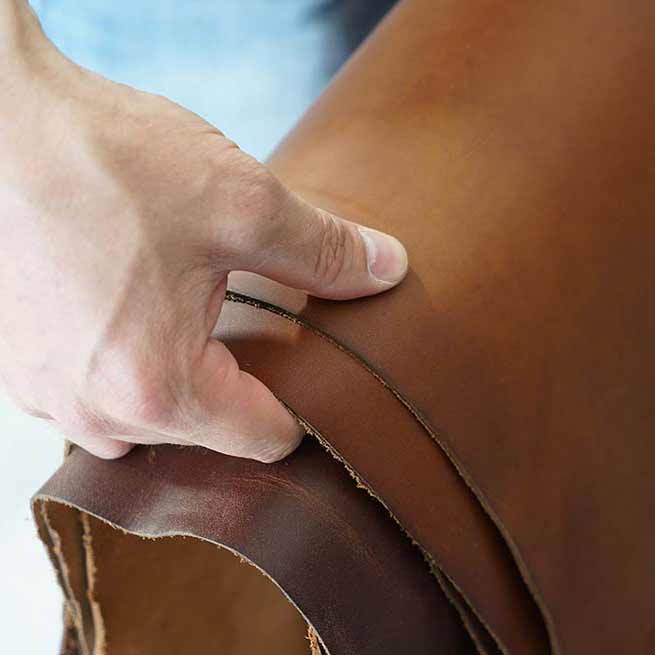
A big word we’re happy to tip our hat to. For us, appreciation starts with 100% made in Germany—and doesn’t end with premium, vegetable-tanned Italian leather. Every piece is made consciously and fairly, with a focus on what matters, one by one.
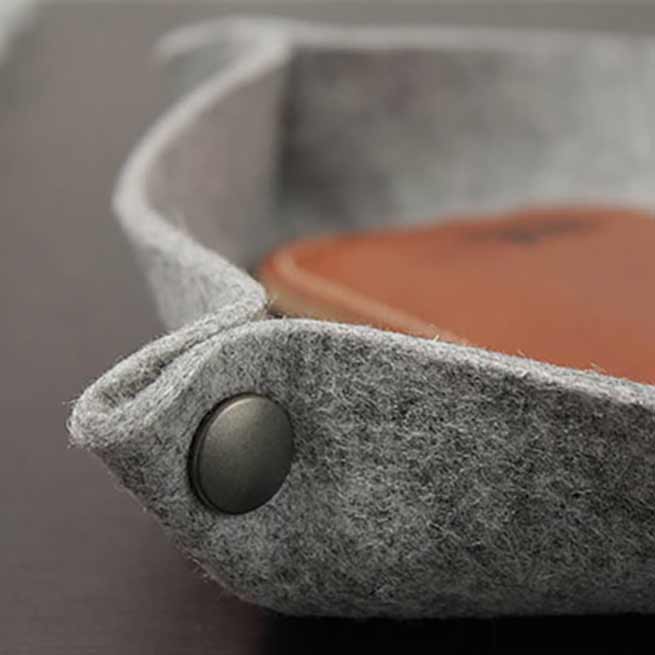
Sounds a little old-fashioned, doesn’t it? But let’s be honest: well-considered, functional aesthetics are timeless. Our products are meant to look great and be purposeful. Hopefully, that never goes out of style.
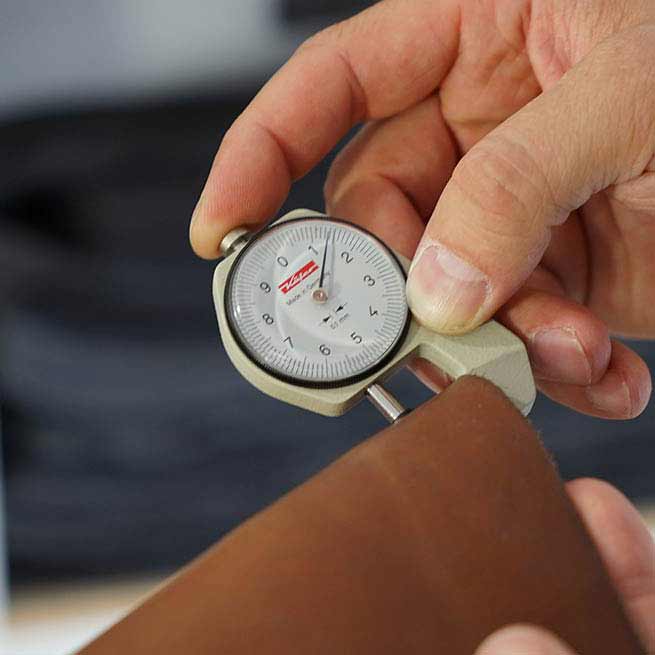
They say you shouldn’t be curious — that’s what kids are told.
Luckily, we were anyway — and still are. We want to know how to make good things even better: why a seam holds more beautifully, how a leather ages more finely, and what you really need to feel content.
Pack & Smooch is a Hamburg-based manufacturer of handcrafted accessories made of Merino wool felt and vegetable-tanned leather. Since 2011 we have been making cases, bags and everyday accessories for iPhone, iPad, MacBook, desk, travel and everyday carry.
Timeless design, genuine materials, clean lines. We create lasting companions, not fast-fashion.
iPhone, iPad, MacBook & AirPods — snug-fit sleeves. iPad sleeves are compatible with Smart Folio/Keyboard and Apple Pencil.
Mulesing-free Merino felt and vegetable-tanned leather — soft, tough, long-lasting, and developing a beautiful patina over time.
We’re a small team—almost like a family. We work with family-run partner workshops in Germany and across the EU. Short routes, fair collaboration, long-term relationships. We support local jobs and produce in small batches—carefully, not mass-produced.


From the first idea to the final stitch: we emboss, sew, and craft in Hamburg. We source our materials responsibly—Merino wool felt from Germany, leather from Tuscany and Germany. Every piece is made with calm precision
Pack & Smooch is a small workshop in Hamburg, Germany. Since 2011 we have been making sleeves and bags for Apple devices from two materials. We believe they are the best materials for this purpose: vegetable-tanned cowhide leather from Tuscany, and Merino wool felt made from pure new wool. We cut, sew, emboss and check every piece in our own workshop. This page explains what that means in detail: which materials we use, which steps a sleeve goes through, and why the fit is what really makes the difference.
More than 30,000 customers have ordered from us since then. Our rating is 4.85 ★ from 1,503 reviews. That is the reason we keep a process that costs more time than the usual one. We do not buy finished sleeves and print a logo on them. We make them, piece by piece, on machines we operate ourselves.
Our leather is vegetable-tanned cowhide from Tuscany, a region where hides have been tanned this way for centuries. It is just under 2 mm thick. That sounds like a small number, but for a device sleeve it is a lot. Two millimetres of leather form a shell that keeps its shape when you push the sleeve into a full bag. Thinner leather simply wraps around the device and passes every pressure straight through.
Vegetable tanning means the hide is preserved with tannins, that is, with tanning agents from bark, wood and fruit. The hides lie in pits for several weeks. The tanning liquid slowly moves from the outside into the core of the fibre. The common alternative, chrome tanning, needs hours instead of weeks and uses chromium salts. It is cheaper, faster, and it gives a leather that looks more even and changes less over time. Vegetable-tanned leather is the opposite: firmer in the hand, warmer in tone, and alive.
You can recognise it without any expert knowledge. It smells warm and woody, not chemical or sweet. The cut edge is coloured all the way through, in a warm brown tone. With chrome-tanned leather you often see a pale, blue-grey core in the cut. A drop of water is not repelled. It sinks in and darkens the spot for a while, until it dries again. And the leather feels warm in your hand within seconds, instead of staying cool.
This open fibre is also the reason for the patina. Light, skin oils and daily use change the surface. The leather gets darker and deeper in colour, and the areas you touch most often become shiny first. After one year your sleeve no longer looks like it did on day one. After three years it looks like no other. Small scars, insect marks or folds from the neck of the hide are not faults. They are proof that the surface was not sanded down and filled in.
Our felt is not a textile in the usual sense. It is not woven and not knitted. It is milled: wool fibres are worked with moisture, heat and pressure until their scales lock into each other and form a closed surface. There is no glue in the material, no carrier layer and no synthetic fibre added. This is why wool felt can be cut without fraying, and why a felt sleeve needs no finished inner edges.
We use 100 percent new wool from Merino sheep, mulesing-free, in a thickness of 3 mm. Mulesing-free means the wool does not come from animals that had skin removed without anaesthetic to prevent parasites. The Merino fibre is finer than ordinary sheep wool. This makes the felt denser and softer without losing its firmness. Wool also absorbs moisture without feeling wet straight away, and it is naturally flame resistant.
Unlike leather, felt hardly changes in appearance. It gets no patina, it does not darken, and it keeps its colour. What does happen is a slight compression: after a few weeks the sleeve becomes a little more supple and fits the device even more closely. On heavily used edges, fine pilling can appear over time, and it can be brushed off. If you want a sleeve that still looks like today in two years, choose felt. If you want people to see those two years, choose leather.
| Feature | Vegetable-tanned cowhide leather | Merino wool felt |
|---|---|---|
| Thickness | just under 2 mm | 3 mm |
| Origin | Tuscany, Italy | 100 percent new wool, mulesing-free |
| Structure | grown hide, vegetable-tanned | milled fibre, no glue |
| Change over time | darkens, develops patina and shine | stays almost unchanged, becomes more supple |
| Protection | firm shell, keeps pressure away from the device | soft padding, absorbs knocks and scratches |
| Care | dust off dry, dab moisture away | shake out, brush off |
| Right for you if | you want the material to tell a story | you want a calm, constant look |
One point often surprises people. The thicker felt models look more protective, but they are not. The best protection comes from our ANGUS, because the firm leather together with the zip all around forms a closed shell that keeps its shape. Felt pads, leather carries.
Between the delivery of a hide and the finished sleeve there are six steps. All of them happen in Hamburg, in our own workshop, and they are carried out by people, not by a machine you set once and let run. Every hide has a different size, a different thickness and different markings. So every piece starts with a decision.
| Step | What happens |
|---|---|
| Splitting | The hide is brought to an exactly even thickness. A grown hide is thicker on the back than on the belly. Without this step, the same sleeve would have more material on one side than on the other, and a different fit. |
| Skiving | Where the piece will later be sewn or folded, we remove material from the back. Only then does a seam stay flat, instead of building up a ridge that gets in the way when you slide the device in. |
| Die cutting | The parts are cut with a tool built for this exact device. The functional openings are made in the same step: sound holes, the charging cable cut-out, and openings for closures. |
| Sewing | The parts are joined. On a slip sleeve the seam is not only a connection, it is construction. Its distance from the edge decides how closely the sleeve sits around the device. |
| Embossing | The lettering is pressed into the material with pressure and heat. It is not printed on. An embossed mark cannot flake off, because there is no colour lying on the surface. |
| Final check | Every piece is checked with the real device: slide in, pull out, close the fastening, inspect the openings. Anything that does not sit properly here does not get shipped. |
A slip sleeve has a difficult job. It has to sit tightly enough that the device does not slide out on its own when you tip your bag. And it has to be wide enough that you can pull the device out with one hand, without holding the sleeve with the other. Between these two demands there is only about one millimetre of tolerance.
This millimetre comes from the cutting, not from purchasing. It comes from the pattern, from the split thickness of the material, from the seam distance, and from the question of how much the material will still settle in the first weeks. This is why we build a separate tool for every device, instead of selling a sleeve that "fits 6.1 to 6.9 inches". A sleeve that fits three devices fits none of them properly.
For the same reason, the KINGSTON is the only one of our sleeves available in two widths, slim and wide. Not because we wanted to sell a second version, but because the iPhone generations it covers differ in depth, and one millimetre of tolerance cannot be set for two device depths at once. You will find the right width on each iPhone leather and wool felt case.
Our models have names instead of numbers, and they differ in purpose rather than in features. Four examples.
KIRKBY and KINGSTON are our iPhone slip sleeves. Both have sound holes, that is, openings at the bottom so the speaker stays audible while the phone is inside the sleeve. Both also have a charging cable cut-out, so you can charge without taking the device out. The KINGSTON is additionally available in two widths. Together, both models cover iPhone generations 12 to 17, from the iPhone 13 case to the iPhone 17 Pro case.
The HAMPSHIRE closes with a magnetic fastening. The magnet sits in a position where the flap finds its correct place again by itself when you let go. This sounds like a detail, but in daily use it is the difference between a closure you actually use and one you leave open after a week.
The ANGUS has a YKK zip that runs all around. We name the maker because the zip is the only moving part on a sleeve, and therefore the part most likely to fail first. A closed ANGUS is sealed on every side: no dust, no sand, nothing that can work its way in along the opening. You will find it among our leather sleeves for iPad and MacBook.
The CORRIEDALE uses a flap instead of a closure. It is the choice for everyone who takes the device out several times a day and does not want to open a zip each time. The front pocket holds flat items such as a charging cable or a notebook. A power adapter does not fit in there, and we prefer to say so before you order. You will find the sizes in our MacBook sleeves and bags and iPad sleeves and bags.
One exception belongs on this page, because this page is about production: the OTLEY, our case for AirPods, is the only product we do not sew in Hamburg. It is made by hand by a partner in China, from the same Tuscan leather. You will find it among the AirPods leather cases.
We do not make mass-market goods. That is not an attitude, it is a consequence of the process. If you split, skive and check every piece by hand, you cannot think in containers. We could multiply the number of our models if we bought finished goods. We decided against it, and that is why our range stays small.
We do not make seasonal colours. A colour that exists for only six months forces you into a new look with your next device, and it turns a purchase meant to last years into a fashion item. Our colours stay in the range.
And we do not build in wear. There are product categories where the short life of an object is the business model. With us it is the other way round: the longer your sleeve lasts, the more likely you are to come back. KIRKBY and KINGSTON cover iPhone generations 12 to 17, from the iPhone 12 case through in-between sizes such as the iPhone 16e case up to the current generation. If you keep your device for four or five years, you will still find a sleeve for it here. If you change devices, you will find the same design for the new one. The same is true for our wallets and card holders and our leather desk mats, which are not tied to a device at all.
Vegetable-tanned leather needs very little. Remove dust and crumbs dry, with a soft cloth or a brush. If the sleeve gets wet, dab the moisture away instead of rubbing. Rubbing spreads the water inside the fibre and leaves a ring. Then let the leather dry at room temperature, lying flat and without the device inside. Not on a radiator, not in the sun, and never with a hair dryer. If leather dries too fast, the fibre contracts, and that damage cannot be reversed. Water marks usually disappear on their own once the patina develops evenly across the surface.
Merino wool felt is even easier. Shaking it out removes most things. Whatever stays can be taken off with a soft brush, always in one direction. Fine pilling on the edges can be brushed off in the same way. Here too: dab moisture away, dry at room temperature, do not wring it out and do not put it in the washing machine, because wool keeps felting under heat and movement and becomes smaller.
Neither material tolerates solvents, wet wipes containing alcohol, or shoe care products. A leather grease made for boots will soften a 2 mm device sleeve and take away exactly the firmness it was built for.
The easiest way to judge the difference between leather and felt is to look at the detail photos. They show cut edges, seams and embossing at a resolution where both materials are easy to tell apart. Start with the iPhone sleeves, the MacBook sleeves, the laptop sleeves in leather and wool felt, or the AirTag keychains and key cases. And if you are looking for something to give as a present that does not look like an accessory, see our leather and wool felt gifts.
If you are not sure which version fits your device, write to us. We have the devices here and we can check. That is the practical advantage of having the workshop and the customer service in the same place, in Hamburg, since 2011.
Handgefertigt in Hamburg seit 2011 – Accessoires aus Merino-Wollfilz und pflanzlich gegerbtem Leder für iPhone, iPad, MacBook und Alltag.


