
iPhone Duo: Apple's first foldable iPhone – and a case has to be rethought
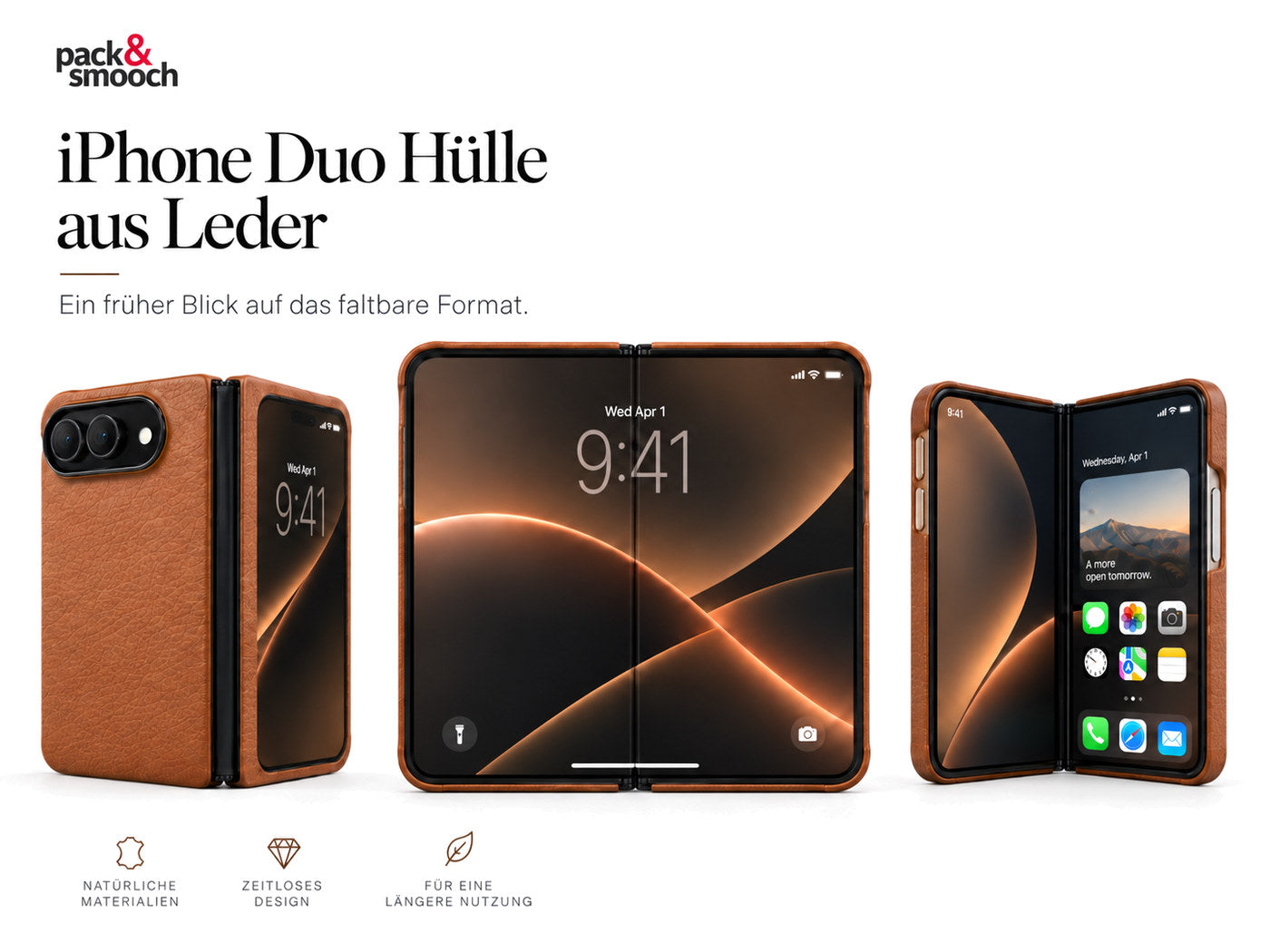
Apple is folding the iPhone. The iPhone Duo can be pre-ordered from 16 October 2026 and is available from 23 October. Every figure in this article comes from Apple's own pages, retrieved on 9 September 2026.
The iPhone Duo is the first iPhone that opens and closes. Closed, it stays a compact smartphone. Opened, it becomes a 7.6-inch inner display, while a 5.4-inch display on the outside handles ordinary use. Apple calls it the largest iPhone display so far.
What interests us about it is not only that Apple is building a foldable iPhone for the first time. The more interesting question is: what does a device like that mean for a case?
Because a foldable iPhone cannot simply be treated like a normal iPhone that happens to have grown a little wider.
It moves. It changes its shape. And a good case has to account for exactly that.
A smartphone closed, almost a small tablet open
Closed, the Duo is meant to work like a normal iPhone. Opened, the way you use it changes considerably. Apple uses a 7.6-inch Super Retina XDR display on the inside. Apps can run side by side, content gets far more room, and the device can be propped up or used at different angles.
For the first time, the line between an iPhone and a small tablet blurs noticeably. And that is what makes the Duo interesting. Not so much because you suddenly own two displays, but because one device can take on quite different jobs depending on the situation.
Answering a message quickly? Closed. Using two apps side by side? Open it. Watching a film or taking a FaceTime call? The Duo can be angled or propped up without necessarily needing a separate stand. Apple has adapted iOS 27 to these different positions and display sizes.
That is probably the real idea behind the device: not simply a bigger iPhone, but an iPhone that adapts its shape to the task.
And that is exactly what makes a case more complicated
With a classic iPhone the job is fairly clear. The case follows a fixed shape. On the iPhone Duo there is a moving part as well: the hinge.
Apple uses a grade 5 titanium frame and hinge cover for it. Add to that Ceramic Shield 2 on the front and Ceramic Shield on the back, a special coating on the inner display, and IP68 protection against water and dust.
A case must not get in the way of that construction. It has to accompany the device when closed. It has to leave enough freedom of movement when opening. And it must not turn an already complex device into a package that looks twice as thick.
That is where the actual product development begins for us. A case is not good because as much material as possible sits on the device. It is good when the material sits exactly where it is needed – and disappears where movement is required.
Our iPhone Duo case will be made from vegetable-tanned leather
So we are working on a leather solution for the new iPhone Duo as well. And we are staying with the material that has shaped many of our iPhone cases for years: fine, vegetable-tanned leather from Italy.
Not a material that tries to look exactly the same forever. Leather that is allowed to be used. It picks up small marks over time. Frequently touched areas grow darker. The surface changes. And after months and years that is what produces the patina that separates natural leather from coated or purely technical materials.
On the iPhone Duo in particular we find that contrast interesting. Inside sits one of the most technically elaborate iPhones Apple has built. Outside lies a material that has been in use for centuries. New technology does not automatically have to look like plastic to us.
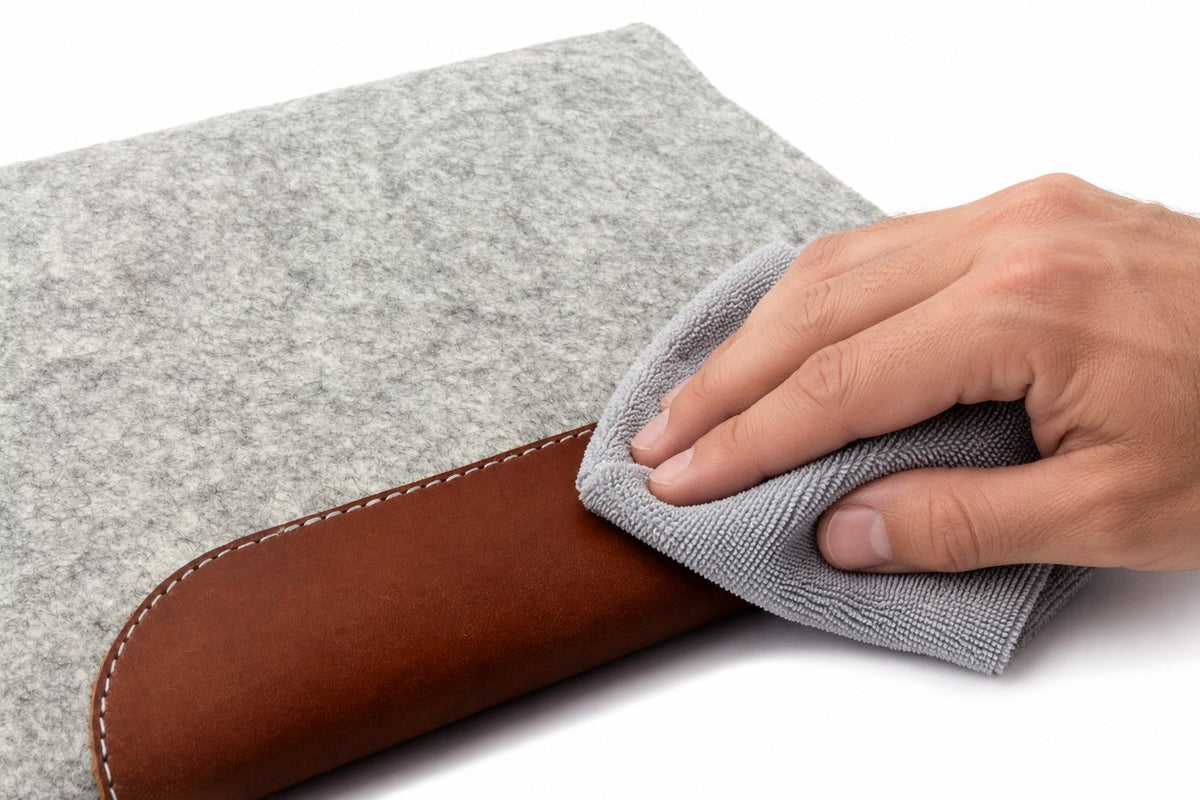
How to keep this leather clean day to day is in the guide Removing stains from leather. The material details for each item are under Material & Care.
Three colours: light brown, dark brown and black
Our leather case for the iPhone Duo will come in the three colours that run through many of our other products.
Light brown is the colour where you will probably see the leather develop most clearly. Light natural leather reacts visibly to light, hands and daily use. It grows darker over time and takes on different shades. If you like patina, this is probably the one.
Dark brown is a little quieter and more classic. It shows the natural change in the leather too, but more discreetly than light brown. For us, a colour that suits a technical product very well without having to look technical itself.
Black is the most restrained option. Black changes its tone the least visually and works particularly well when the case should stay quiet.
Three colours. The same leather. But after a year, probably three quite different stories.
A foldable iPhone raises new questions about protection too
Apple itself offers an iPhone Duo Case and an iPhone Duo Folio with Kickstand, among others. That alone shows how the accessory concept changes compared with a classic iPhone.
For us that mainly means: we do not want to simply scale up existing solutions and somehow transfer them to the Duo. The construction has to suit the device. The hinge has to work freely. Opening and closing must not become unnecessarily awkward. Edges, camera and outer surfaces need protection without losing the original idea of a thin foldable design.
Because that would be the worst possible outcome: Apple invests enormous development work so that a foldable device stays as thin as possible – and we then build a case around it that makes that advantage disappear again. Technically that might be feasible. Good design it would not be, not for us.
The iPhone Duo opens up new possibilities for the camera as well
Apple fits a 48 MP Dual Fusion camera system with a main and an ultra-wide camera. More interesting than the megapixel count, though, are the functions that only become possible through the two displays.
The person in front of the camera can see a preview on the outer display, for instance, while the photo is being taken from the other side. Apple uses the different display positions for FaceTime and group shots as well.
Here too you can tell: Apple is not using the fold just so it can say the iPhone folds. The hardware genuinely changes how the device is operated. That is what separates an interesting new format from a purely technical gimmick.
A20 Pro, two batteries and a surprising amount of display
Inside works the A20 Pro chip. For the Duo, Apple is also using a dual battery system for the first time and states up to 31 hours of video playback on the inner display and up to 44 hours on the outer one. According to Apple, the large inner display is 50 percent larger than the display of the iPhone 18 Pro Max.
| Feature | Figure |
|---|---|
| Inner display | 7.6-inch Super Retina XDR, foldable OLED |
| Outer display | 5.4-inch Super Retina XDR OLED |
| Size comparison | 50 percent larger than the iPhone 18 Pro Max |
| Frame and hinge cover | Grade 5 titanium |
| Front and back | Ceramic Shield 2 front, Ceramic Shield back |
| Protection rating | IP68, up to 6 metres for 30 minutes |
| Chip | A20 Pro |
| Battery | two batteries, up to 31 hours video inside, up to 44 hours outside |
| Camera | 48 MP Dual Fusion, main and ultra-wide |
| Port | USB-C |
| Dimensions closed | 84.1 × 117.8 × 11.3 mm |
| Dimensions open | 164.6 × 117.8 × 5.2 mm |
| Weight | 254 g |
| Operating system | iOS 27 |
| Pre-order | 16 October 2026 |
| Available | 23 October 2026 |
Whether the concept really works day to day will only become clear once the devices are actually out. Technical figures tell only part of the story.
Frequently asked questions about the iPhone Duo
When is the iPhone Duo coming?
Pre-orders open on 16 October 2026, and the device is available from 23 October 2026. Both dates come from Apple.
How big is the iPhone Duo?
Closed 84.1 × 117.8 × 11.3 mm, open 164.6 × 117.8 × 5.2 mm, at 254 g. Two thicknesses and a hinge side – which is exactly what makes the case a job of its own.
Will a case for the iPhone 18 Pro fit the Duo?
No. A folding device has two backs, a hinge, and a completely different thickness closed than open. A standard cut does not help there.
When will your leather case for the Duo be available?
As soon as we have measured on the actual device. We deliberately do not name a date before the fit is settled.
Why we would rather wait for the real device
With new Apple devices we work as precisely as we can. On the iPhone Duo that matters more than ever. A few tenths of a millimetre that would barely show on a simple case can suddenly be decisive at a hinge, or where two parts of a device move against each other.
So this is not about calling some case a match as quickly as possible. We want to see how the real device sits, opens and closes. Where material needs room. And where it deliberately should not sit.
A precise fit does not mean taking dimensions off a spec sheet. It means holding the real device and developing the case around it.
iPhone Duo and leather – two worlds that can go together well
The iPhone Duo is probably one of the most unusual iPhones in a long time. A foldable display. Two usable screen sides. Titanium around the frame and hinge. A device that can be a smartphone, a large display or a small propped-up screen depending on the situation.
And on the outside? For us it can still be something very simple. Good leather. Cleanly finished. As little construction as possible.
Our iPhone Duo case will therefore come in light brown, dark brown and black, made from fine vegetable-tanned leather from Italy. Not to turn the Duo into a different device. But to achieve the opposite: respect the new shape, protect it, and still add as little as possible.
That is a challenge on a normal iPhone already. On the first foldable iPhone it gets genuinely interesting.
What is available today
For the current models our sizes are settled.